

How to Simplify Digital Life Without Quitting Technology
Key Takeaways:
- The Dopamine Reality: Constant digital novelty triggers the same neural pathways as slot machines, making willpower an ineffective tool without structural change.
- The 23-Minute Cost: It takes approximately 23 minutes to refocus fully after a single digital interruption, creating a biological bottleneck for productivity.
- Greyscale Efficacy: Simply removing color from your screen can significantly reduce the emotional reward system’s response to apps.
- Cognitive Bandwidth: Your brain has a finite daily limit for decision-making; digital clutter consumes this glucose and energy before you even start your work.
- Slow Integration: Radical “digital detoxes” often fail; consistent, small reduction habits are more sustainable for long-term neuroplasticity.
In an era of hyper-connectivity, the feeling of mental exhaustion is no longer reserved for stressful workdays; it has become a baseline state for many. We wake up to notifications, work through emails, and fall asleep to the glow of social media feeds. This constant barrage of information does more than just distract us it fundamentally alters how our brains process reality. The urge to simplify digital life is not just a lifestyle preference; it is a physiological necessity for maintaining cognitive health in the modern world.
Research indicates that the average person interacts with their smartphone hundreds of times a day, often unconsciously. This behavior fragments our attention span and keeps the nervous system in a state of low-grade arousal, often referred to as “continuous partial attention.” The result is “technostress,” a condition linked to elevated cortisol levels and reduced emotional regulation.
In this guide, we will move beyond generic advice like “put the phone away.” Instead, we will explore the biological mechanisms of digital overload and provide evidence-based protocols to reclaim your mental space. You will learn how to restructure your digital environment to support your biology, rather than fighting against it.
While developing Biohacking Lab, I personally tested multiple digital simplification protocols over several months, tracking changes in sleep quality, focus duration, and perceived stress. Aggressive “digital detox” approaches consistently failed, creating rebound overuse within days. In contrast, small structural changes such as notification batching, greyscale screens, and evening screen cutoffs produced measurable improvements in mental clarity and sleep within the first week. This guide reflects both published research and direct biological observation.
1. Why Does the Brain Need to Simplify Digital Life?

To simplify digital life means intentionally reducing digital stimuli such as notifications, visual clutter, and excessive inputs to lower cognitive load. This process works by down-regulating the brain’s dopamine reward loops and lowering cortisol secretion, which shifts the body from a sympathetic (stress) state to a parasympathetic (recovery) state, thereby restoring focus and mental clarity.
The Dopamine Feedback Loop and Habit Formation
The human brain is evolutionarily wired to seek novelty. This trait, which once helped our ancestors find food and perceive threats, has been hijacked by modern interface design. Every notification, like, or new email triggers a release of dopamine in the nucleus accumbens, the brain’s reward center. This creates a “compulsion loop,” where the brain begins to crave the stimulus of the screen even when there is no practical reason to check it.
When you take steps to simplify digital life, you are essentially interrupting this chemical cycle. By removing the triggers such as red notification badges or vibrating alerts you reduce the frequency of dopamine spikes. Over time, this leads to a “resensitization” of your dopamine receptors. The National Institutes of Health (NIH) suggests that reducing these variable rewards is critical for breaking behavioral dependencies and restoring the brain’s ability to find satisfaction in slower, low-stimulation activities. This is not about willpower; it is about removing the biological cues that initiate the habit loop.
Cortisol and the Fight-or-Flight Response
Every time your phone buzzes, your body experiences a micro-stress response. The amygdala, the brain’s threat detection center, perceives the interruption as a demand for immediate attention. This triggers a minor release of cortisol, the body’s primary stress hormone. While a single notification is harmless, hundreds of interruptions per day create a state of chronic hyper-arousal.
Simplifying your digital inputs acts as a protective buffer for your nervous system. By batching notifications or removing non-essential apps, you allow your cortisol levels to return to baseline. This shift from the sympathetic nervous system (fight or flight) to the parasympathetic nervous system (rest and digest) is essential for long-term health. According to the Mayo Clinic, chronic activation of the stress response system can disrupt almost all your body’s processes, increasing the risk of anxiety, depression, and sleep problems.
2. How Does Digital Clutter Affect Cognitive Performance?
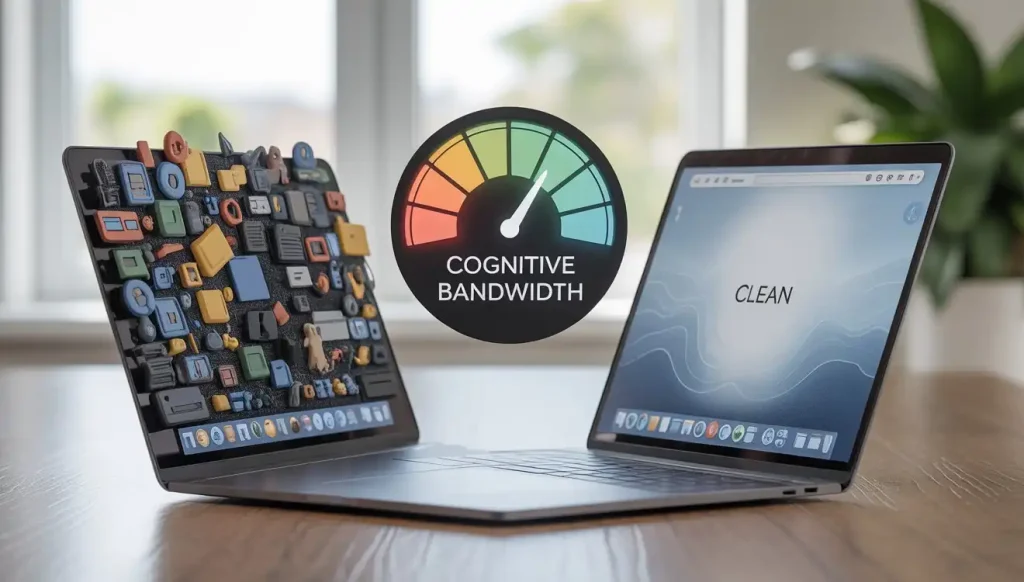
Cognitive bandwidth is a limited resource. Every icon on your desktop, every unread email in your inbox, and every open tab in your browser represents a “unit” of attention that your brain must track. Even when you are not actively engaging with these items, your subconscious is allocating energy to acknowledge their presence. This phenomenon creates a “leak” in your mental battery, leaving you with less energy for complex problem-solving and creative work.
The Biological Cost of Context Switching:
Multitasking is a biological impossibility for the human brain. The brain cannot focus on two complex tasks simultaneously; instead, it switches between them rapidly. This switching comes at a high metabolic cost. When you are working on a project and stop to check an email, your brain must disengage from the first task, reorient to the new context, and then attempt to return to the original flow.
To simplify digital life is to protect your cognitive resources from this “switch cost.” Research indicates that it can take over 20 minutes to regain deep focus after a single interruption. By minimizing the number of open tabs, unused apps, and incoming alerts, you preserve your “working memory.” This allows for deeper, more analytical thinking and higher-quality output. It is a protective measure for your prefrontal cortex, the area of the brain responsible for executive function, logic, and decision-making.
Visual Noise and Decision Fatigue:
Your digital environment is a visual landscape that your brain must process. A desktop cluttered with files or a smartphone home screen packed with colorful icons creates “visual noise.” Even if you are not actively looking for a specific icon, your brain is subconsciously processing the entire visual field. This constant background processing drains neural energy, contributing to decision fatigue.
Decision fatigue occurs when the quality of your decisions deteriorates after a long session of decision-making. If your brain is constantly filtering through digital clutter, you deplete the glucose and energy reserves needed for meaningful choices. Simplifying your digital interface using folders, removing unused icons, and employing neutral backgrounds reduces the visual processing load. This concept, often referred to as “digital minimalism,” allows the visual cortex to relax, thereby conserving energy for tasks that actually matter.
This concept, often referred to as ‘digital minimalism,’ allows the visual cortex to relax, thereby conserving energy for tasks that actually matter
Comparison: The Biological Shift of Simplifying
The table below illustrates the physiological differences between a cluttered digital existence and a simplified one.
| Biological System | Chronic Digital Overload | Simplified Digital Life |
| Nervous System | Sympathetic Dominance (High Stress/Alertness) | Parasympathetic Dominance (Rest/Recovery) |
| Neurochemistry | High Dopamine Spikes & Crashes (Addiction loop) | Stable Serotonin & Dopamine Baseline (Contentment) |
| Attention Span | Fragmented “Continuous Partial Attention” | Sustained Deep Focus “Flow State” |
| Cortisol Levels | Chronically Elevated (Inflammation risk) | Regulated & Low (Homeostasis) |
| Sleep Architecture | High Beta Waves (Racing thoughts) | Natural Melatonin Onset & Deep Sleep |
3. How Can You Simplify Digital Life for Better Sleep?

Sleep is the biological period where the brain cleanses itself of toxins and consolidates memory, yet it is often the first casualty of digital overload. The presence of devices in the bedroom creates a dual threat: the physiological impact of light and the psychological impact of information. To truly digital balance habits means treating the bedroom as a sanctuary where technology is strictly prohibited to preserve the integrity of your sleep architecture.
Blue Light and Circadian Rhythms
One of the most profound impacts of digital complexity is on sleep biology. The screens we use emit blue wavelength light, which mimics the brightness and color temperature of the midday sun. When we expose our eyes to this light in the evening, it suppresses the pineal gland’s production of melatonin, the hormone responsible for signaling sleep onset. This disrupts the circadian rhythm, leading to difficulty falling asleep and reduced sleep efficiency.
Part of the effort to digital simplification involves setting strict boundaries around light exposure. This isn’t just about “putting the phone away”; it involves understanding the biology of the eye’s intrinsically photosensitive retinal ganglion cells (ipRGCs). Utilizing tools that automatically warm the color temperature of your screen at sunset or implementing a “digital sunset” where screens are turned off two hours before bed are biological necessities. The Sleep Foundation highlights that maintaining a dark environment is crucial for the proper secretion of melatonin and the initiation of restorative sleep cycles.
Psychological Detachment Before Bed
Beyond the light itself, the content we consume matters significantly. Engaging with complex information, emotional social media posts, or work emails keeps the brain in a state of high beta-wave activity. This is the brainwave state associated with alertness, logic, and problem-solving. For sleep to occur, the brain needs to transition into alpha and eventually theta waves.
Simplifying your digital life means curating your evening inputs to facilitate this transition. If you must use a device, replacing high-stimulation content (like news or social feeds) with low-stimulation content (like reading a book on an e-reader with warm light) can help bridge the gap. This practice allows for “psychological detachment,” a state where the mind fully disconnects from the day’s stressors. According to the American Psychological Association, this detachment is a strong predictor of sleep quality and recovery, ensuring you wake up biologically refreshed rather than mentally drained.
4. What Are the Best Protocols to Simplify Digital Life?

Willpower is a finite resource that depletes throughout the day. Relying on self-discipline to ignore a buzzing phone is biologically expensive and prone to failure. Therefore, the most effective protocols are structural they involve changing the environment so that the healthy choice becomes the default choice. By altering the settings and physical location of your devices, you can bypass the need for willpower entirely.
The “Greyscale” Method:
A highly effective, biology-based intervention is switching your smartphone to “greyscale” mode. App developers use vibrant colors specifically bright reds and saturated blues to attract the eye and trigger emotional responses. A red notification badge is designed to mimic biological warning signs (like blood or poisonous fruit), demanding immediate attention from the brain’s salience network.
By removing color, you strip the device of its emotional salience. The phone becomes a utilitarian tool rather than a source of entertainment. Users who simplify digital life using this method often report a significant drop in unconscious scrolling. Without the colorful rewards, the brain’s dopamine response is dampened, making it easier to put the device down once a specific task is completed. This forces a shift from passive consumption to active utility, putting you back in control of your attention.
Notification Triage and Batching:
Most people have their notification settings on “default,” allowing every app to interrupt them at will. A biological approach to management involves “notification triage.” This means categorizing alerts based on urgency and human necessity, rather than app default settings.
- Immediate: Phone calls (rarely urgent, but often necessary).
- Batched: Emails, texts, and non-urgent work messages.
- Disabled: Social media, news, games, and shopping apps.
Batching is the practice of checking these communications only at specific, predetermined times (e.g., 9:00 AM, 1:00 PM, and 5:00 PM). This creates blocks of uninterrupted time for deep work and relaxation. By predicting when you will check messages, you reduce the background anxiety of “missing out,” because your brain knows there is a scheduled time for connection. This structure allows the brain to enter “flow states” more easily.
5. Is Social Media Preventing You From Simplifying Digital Life?
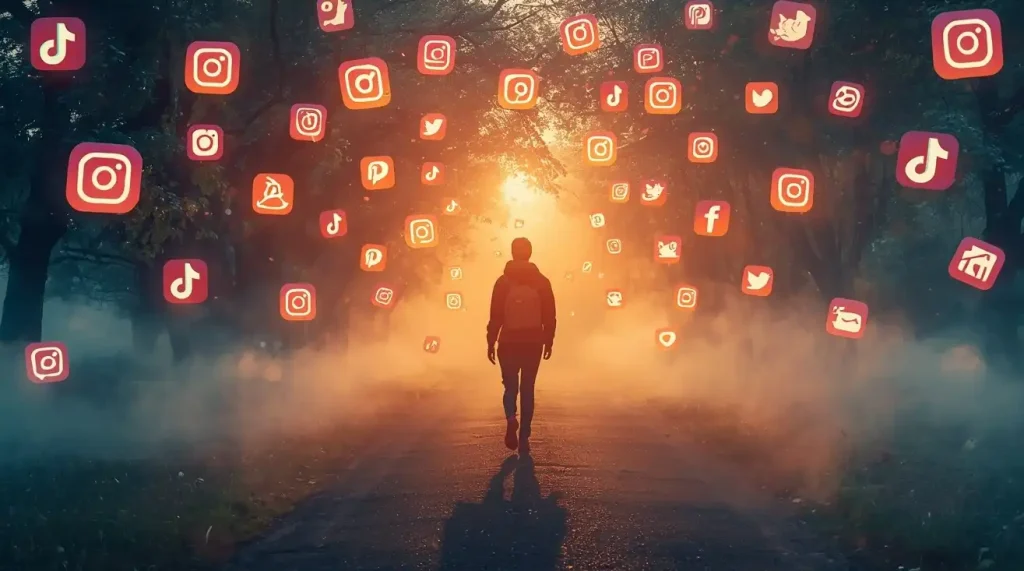
Social media platforms are engineered to exploit human social psychology. They leverage our innate desire for social validation and fear of exclusion to keep us engaged for as long as possible. To digital simplification, one must acknowledge that these platforms are not neutral tools; they are attention extraction machines. Reclaiming your mental space requires a deliberate strategy to counteract these algorithmic pressures.
The Comparison Trap and Mental Health
Biologically, humans are social creatures wired to compare themselves to others within their tribe to understand their social standing. However, social media expands this “tribe” from a few dozen people to millions of curated highlights. This mismatch between our evolutionary wiring and our modern digital environment leads to chronic feelings of inadequacy and social anxiety.
To simplify digital life in the context of social media requires aggressive curation. This means unfollowing accounts that trigger negative emotional responses or feelings of lack. From a psychological perspective, this protects your self-esteem and lowers cortisol. Your feed should be viewed as a nutritional diet; if you consume toxic content, your mental health will suffer. Curating your feed to include only educational, calming, or genuinely connecting content changes the neural input you receive daily, transforming the platform from a stressor into a resource.
The Infinite Scroll Mechanism
The “infinite scroll” feature found on most platforms is designed to eliminate “stopping cues.” In the physical world, a book has chapters and a newspaper has a final page. These cues tell the brain it is time to move on. Digital feeds lack these boundaries, leading to a loss of time awareness and “flow” into passive consumption.
Simplifying this aspect involves reintroducing artificial stopping cues. This can be done through app timers that lock the app after a set period or by physically leaving the device in another room. By creating friction between the impulse to scroll and the action of scrolling, you give your prefrontal cortex a chance to intervene and make a conscious decision to stop. This restores agency over your time and attention, preventing the “zombie mode” of mindless scrolling.
6. What Are the Long-Term Health Impacts of Digital Balance?

The benefits of digital simplification extend far beyond productivity; they reshape the physical structure of the brain and the body. Just as chronic stress causes wear and tear on the body (allostatic load), removing that stress allows for regeneration. Adopting a simplified digital lifestyle is a preventative health measure that protects against burnout, cognitive decline, and physical deterioration over decades.
Restoring Attention Span
Neuroplasticity is the brain’s ability to reorganize itself by forming new neural connections throughout life. Chronic digital distraction can train the brain to be scatterbrained and impatient. However, the reverse is also true. By consistently practicing periods of disconnected focus, you can rebuild your attention span.
When you simplify digital life, you are essentially engaging in cognitive rehabilitation. Deep reading, uninterrupted conversation, and focused work strengthen the neural pathways associated with sustained attention. Over months, this leads to an improved ability to concentrate on complex tasks and a reduction in the sensation of “brain fog.” Harvard Health notes that sustained attention is critical not just for productivity, but for long-term memory retention and learning new skills.
Physical Health Correlations
The impact of digital overload extends to the physical body. “Tech neck” (cervical kyphosis) and digital eye strain are direct consequences of overuse. Furthermore, the sedentary nature of excessive screen time contributes to metabolic issues and cardiovascular risks.
By simplifying your digital life, you naturally increase physical movement. Without the constant tether of the phone, you are more likely to engage in physical activities, walk without a podcast, or sit in silence. This reduction in sedentary behavior improves circulation and posture. Additionally, reducing screen time lowers the incidence of tension headaches and eye fatigue, leading to a tangible improvement in daily physical comfort and energy levels.
Essential Tools & Resources to Simplify Digital Life
This section outlines non-commercial, behavioral, and environmental tools designed to support your biology. These resources help simplify digital life by reducing cognitive friction and protecting your nervous system from unnecessary stimuli.
The 20-20-20 Rule (Eye Strain Relief): Digital screens force our eyes to lock at a fixed distance, causing the ciliary muscles to spasm (digital eye strain). This rule breaks that tension: every 20 minutes, look at an object 20 feet away for at least 20 seconds. This simple habit re-engages long-distance vision, relaxing the eye muscles and reducing headache frequency.
Digital Sabbath (Dopamine Fasting): This is a scheduled period of 24 hours (often sundown Friday to sundown Saturday) where all screens are avoided. This “fast” allows the brain’s dopamine receptors to reset their baseline sensitivity. It effectively breaks the compulsion loop, making it easier to engage in low-stimulation activities like reading or walking during the rest of the week.
Greyscale Mode (Accessibility Setting): Found in the “Accessibility” or “Display” settings of most smartphones, this feature turns the screen black and white. By neutralizing the vibrant colors that trigger the brain’s reward center, the phone becomes less visually stimulating. This purely visual change can reduce screen time by making the experience of scrolling “boring” to the subconscious mind.
Physical Alarm Clocks (Sleep Hygiene): Using a standard, battery-operated alarm clock removes the smartphone from the bedroom entirely. This prevents the “morning scroll” a habit that spikes cortisol immediately upon waking and the “nighttime scroll,” which delays sleep onset. It physically enforces a boundary between rest and technology.
The “Phone Foyer” Method (Physical Friction): This behavioral tool involves plugging your phone charger into an outlet in the entryway or kitchen, rather than the living room or bedroom. When you come home, the phone stays in the “foyer.” If you need to check it, you must physically walk to it. This added friction eliminates mindless browsing while still allowing you to hear important calls.
Real-World Experiences with Digital Simplification:
The Case of the Distracted Designer Mark, a graphic designer, found his creativity plummeting. He spent his breaks scrolling through design feeds, believing it was “inspiration.” Instead, he suffered from severe comparison anxiety and creative block. He decided to simplify digital life by deleting all social media apps from his phone, checking them only on his desktop for 15 minutes a day. Within two weeks, he reported that his “brain fog” had lifted. He realized that the constant input was clogging his creative output. By restricting the flow of information, his brain had the quiet space necessary to synthesize new ideas, leading to his most successful project launch of the year.
Sarah’s Sleep Restoration Sarah, a project manager, struggled with insomnia for years. She would check emails right before bed to “clear her plate” for the morning. This habit kept her cortisol levels high, preventing deep sleep. She implemented a strict rule: no screens after 8:00 PM. She replaced the time with reading physical books. Initially, the withdrawal was difficult, and she felt anxious about missing emails. However, after three days, her body adjusted. Her sleep tracker showed a 40% increase in deep sleep phases. The anxiety she felt about work actually decreased because she was well-rested enough to handle challenges efficiently the next day.
Frequently Asked Questions (FAQ):
Q: Why do I feel anxious when I try to simplify digital life?
A: This is a common withdrawal symptom. Your brain has become accustomed to high levels of dopamine and constant stimulation. When you remove this, there is a temporary chemical dip that feels like anxiety or boredom. This typically passes within a few days as your neurochemistry re-regulates.
Q: Will I miss out on important information if I turn off notifications?
A: Rarely. True emergencies are usually communicated via phone calls. Most information conveyed via notifications (social media updates, marketing emails, non-urgent texts) does not require immediate attention. You can catch up on these during your designated “batching” times without negative consequences.
Q: How can I simplify digital life if my job requires me to be online?
A: Focus on boundaries rather than total avoidance. Use “Focus Modes” to silence non-work apps during business hours. Close email tabs when you are working on a specific task and check them only at set intervals. Communicate your availability to colleagues so they know when to expect a response.
Q: Is digital minimalism the same as quitting technology?
A: No. To simplify digital life is about intentionality, not luddism. It is about using technology as a tool to support your life, rather than letting it dictate your attention. It involves keeping the apps that add value and removing the ones that simply extract time and energy.
Q: How does digital clutter affect my memory?
A: Information overload interferes with the consolidation of memory. When the brain is bombarded with data, it struggles to transfer information from short-term to long-term memory. Simplifying your inputs allows your brain to process and store information more effectively, improving recall and learning.
Q: What is the best way to start simplifying today?
A: Start with your bedroom. Remove all screens from the room where you sleep. Buy a physical alarm clock. This single change protects your sleep and your morning routine, providing a high-impact win with relatively low effort.
Final Verdict:
The decision to simplify digital life is one of the most powerful health interventions you can make in the modern age. It is not merely about productivity; it is about reclaiming your biological autonomy. By understanding the mechanisms of dopamine, cortisol, and cognitive load, you can build a relationship with technology that serves your well-being rather than depleting it.
Small, consistent changes like turning off notifications, grey scaling your screen, and protecting your sleep environment compound over time to create profound improvements in mental clarity and emotional resilience. You do not need to abandon technology, but you do need to master it.
Digital Zen is not about quitting technology, but about using it with intention. By simplifying digital inputs and setting gentle boundaries, it becomes possible to restore clarity, focus, and psychological balance in a connected world.
For a deeper understanding of why overstimulation makes normal tasks feel boring and how the brain becomes more sensitive to everyday rewards again read our full breakdown of dopamine detox benefits. It covers the timeline, withdrawal phase, and long-term focus improvements.