
How Red Light Therapy Heals Acne Scars at the Cellular Level
Key Takeaways:
- Cellular Energy: Red light therapy works by stimulating mitochondria to produce more ATP, essentially giving skin cells the energy required to repair tissue.
- Wavelength Matters: Effective treatment typically utilizes specific wavelengths in the 630nm to 670nm range, which penetrate the skin to the necessary depth for healing.
- Patience is Biological: This is not an overnight fix; visible collagen remodeling and scar reduction typically require 8 to 12 weeks of consistent exposure.
- Non-Invasive Nature: Unlike chemical peels or lasers that damage skin to trigger repair, red light therapy is non-ablative, meaning it heals without causing initial injury.
- Consistency is Key: The biological response relies on cumulative exposure; sporadic sessions generally fail to trigger the necessary fibroblast activity.
Acne scarring is one of the most persistent and emotionally taxing skin challenges, often lasting long after the active breakouts have subsided. For many, the search for a solution involves a cycle of harsh topicals or abrasive treatments that strip the skin barrier. However, modern dermatological science has shifted focus toward working with the body’s natural healing mechanisms rather than fighting against them.
This is where photobiomodulation enters the picture , commonly known as red light therapy.
Rather than relying on surface-level exfoliation, this approach utilizes specific wavelengths of light to penetrate the dermis and stimulate cellular regeneration from within. The science suggests that by energizing the mitochondria the powerhouse of the cell we can accelerate the repair of damaged tissue and smooth out uneven texture.
In this guide, you will learn exactly how red light therapy for acne scars functions at a biological level, the timeline for realistic results, and the science behind why consistency matters more than intensity. According to the Cleveland Clinic, non-invasive therapies like this are becoming a cornerstone of skin health because they minimize the risk of irritation while promoting long-term healing.
1. Understanding the Biology of Photobiomodulation:
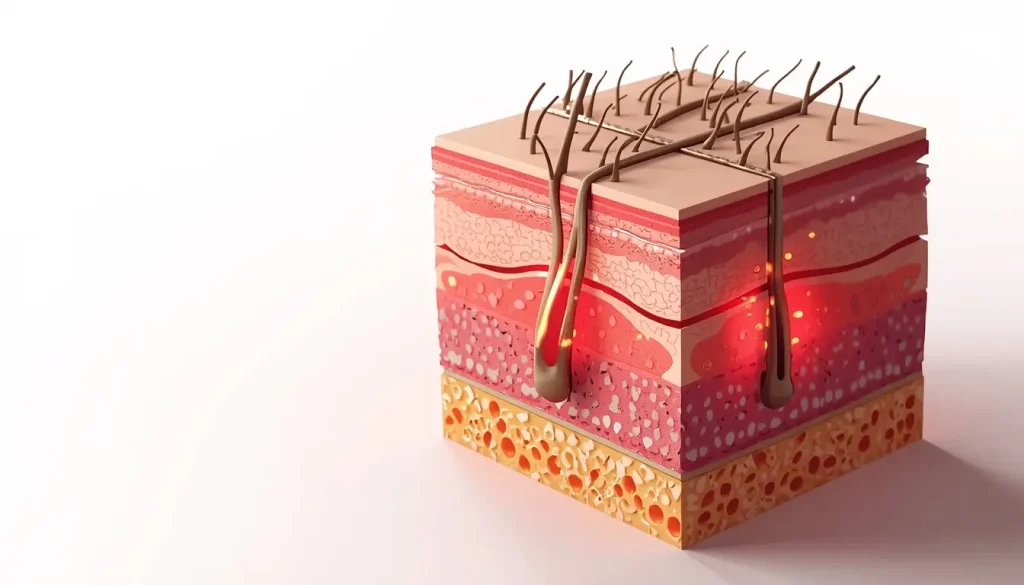
Red light therapy for acne scars works through a process called photobiomodulation (PBM). Specific wavelengths of light (typically 630nm–670nm) penetrate the skin and are absorbed by the mitochondria in your cells. This absorption stimulates the production of Adenosine Triphosphate (ATP), providing the cellular energy necessary to accelerate tissue repair, reduce inflammation, and stimulate fibroblast activity for new collagen production.
The Role of Mitochondria and ATP:
To understand why light can heal a physical scar, we must look at the cellular level. Every cell in the human body contains mitochondria, organelles responsible for generating energy. When skin is damaged by acne, the cells in that area are often in a state of oxidative stress or are simply depleted of the energy required to repair the complex matrix of the skin.
Research published by the National Institutes of Health (NIH) indicates that the cytochrome c oxidase enzyme within mitochondria is particularly sensitive to red light. When this enzyme absorbs light energy, it boosts the efficiency of the respiratory chain within the cell. This results in a significant increase in ATP (Adenosine Triphosphate) production. Think of ATP as the fuel tank for your cells; with a full tank, your skin cells can perform the energy-intensive work of regeneration and repair that they cannot perform when depleted.
Reducing Chronic Inflammation:
Scarring is often the result of the body’s chaotic attempt to heal a wound rapidly. In the case of acne, the inflammation from a breakout causes trauma to the skin tissue. Even after the pimple is gone, low-grade inflammation can persist, preventing the collagen matrix from forming neatly.
Red light therapy for acne scars helps to modulate this inflammatory response. By reducing the presence of pro-inflammatory cytokines, the therapy allows the skin to exit the “emergency” phase of wound healing and enter the “remodeling” phase. This creates a calmer biological environment where the skin can focus on organized tissue repair rather than fighting off perceived threats.
By understanding this distinction, you can better understand why different protocols exist for different goals, such as skin health versus muscle recovery.
2. How Red Light Therapy Impacts Collagen and Fibroblasts:
Stimulating Fibroblast Activity:
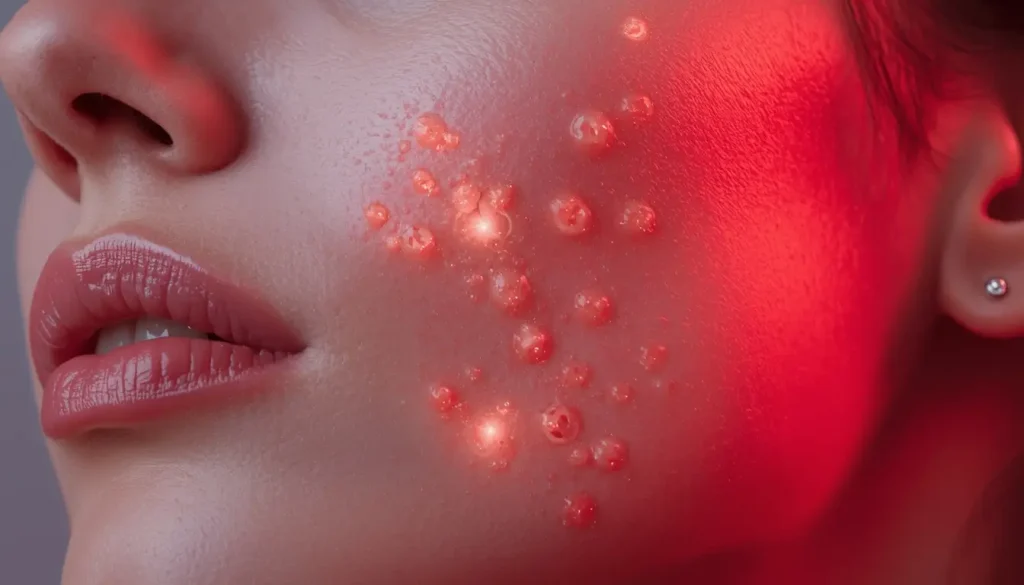
The primary structural protein in your skin is collagen. When you have atrophic (indented) acne scars, it is essentially a signal that there is a deficiency of collagen in that specific spot. The “divots” or “pockmarks” occur because the underlying support structure of the skin was destroyed by the acne infection and was not adequately replaced during healing.
Fibroblasts are the specific cells in the dermis responsible for manufacturing collagen and elastin. Red light therapy for acne scars is effective largely because it directly stimulates these fibroblasts. When energized by the increased ATP mentioned earlier, fibroblasts become more active and efficient. They begin to lay down new collagen fibers, which, over time, can help to “plump” the indented areas from the bottom up.
Improving Collagen Alignment:
It is not just about the amount of collagen produced, but also the quality and alignment. In scar tissue, collagen fibers often grow in a disorganized, cross-hatched pattern, which looks different from the smooth, basket-weave pattern of healthy skin.
Studies suggest that photobiomodulation can influence the alignment of these regenerating fibers. By promoting a more organized deposition of collagen, the texture of the skin becomes smoother. While this does not mean the scar tissue will completely vanish, the visual appearance of the scar blends more seamlessly with the surrounding healthy tissue. This remodeling process is slow biological tissue changes take weeks to months but the structural integrity of the skin improves fundamentally.
3. Differentiating Between Scar Types and Results:
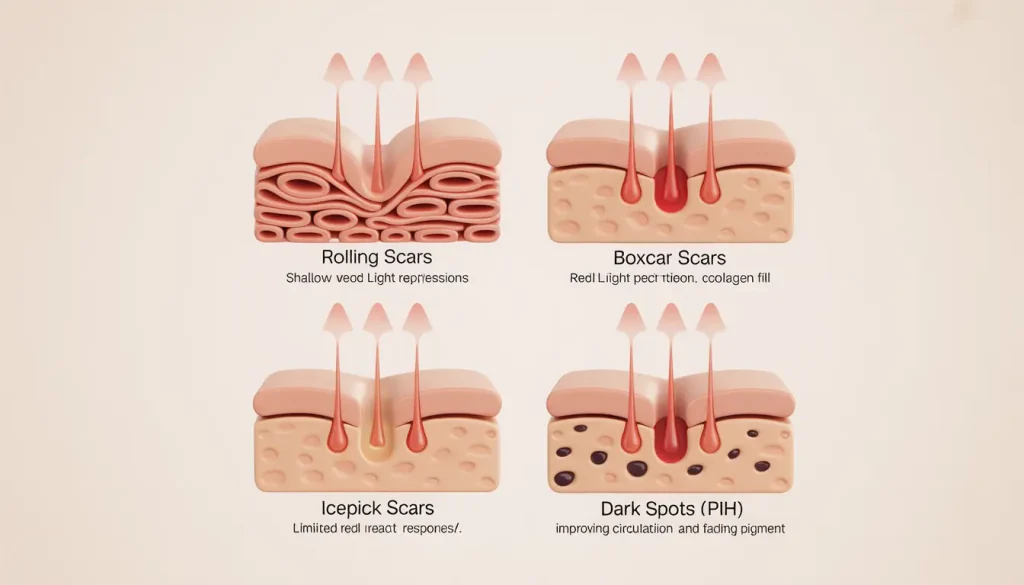
Atrophic Scars (Boxcar, Icepick, Rolling)
Atrophic scars are the most common type associated with acne, characterized by depressions in the skin. These are the primary targets for red light therapy for acne scars because the mechanism of action involves building new tissue.
Biological Responsiveness by Scar Type:
Not all scars respond to light therapy in the same way. This table outlines the biological response you can expect based on the type of scarring you have.ween Scar Types and Results:
| Scar Type | Description | Responsiveness to Red Light | Biological Mechanism |
| Rolling Scars | Smooth edges; wave-like appearance. | High | Fibroblast stimulation lifts the depression effectively as the skin is flexible. |
| Boxcar Scars | Sharp, defined edges; box-like shape. | Moderate | Helps raise the scar floor, but may not smooth the sharp edges completely. |
| Icepick Scars | Deep, narrow, V-shaped punctures. | Low | The damage is too deep for significant remodeling via light alone; usually requires microneedling combinations. |
| PIH (Dark Spots) | Red or brown discoloration (not indented). | Very High | Increases circulation and cellular turnover to flush out pigment deposits. |
Post-Inflammatory Hyperpigmentation (PIH)
While not technically a “scar” (it is a pigment change), the dark spots left behind by acne are often grouped into the same conversation. Red light therapy is notably effective here. By increasing blood flow and circulation to the area, the therapy helps flush out waste products and speeds up the turnover of skin cells. This accelerated turnover helps fade the red or brown marks faster than the skin’s natural cycle would allow.
4. The Importance of Wavelengths and Penetration Depth:
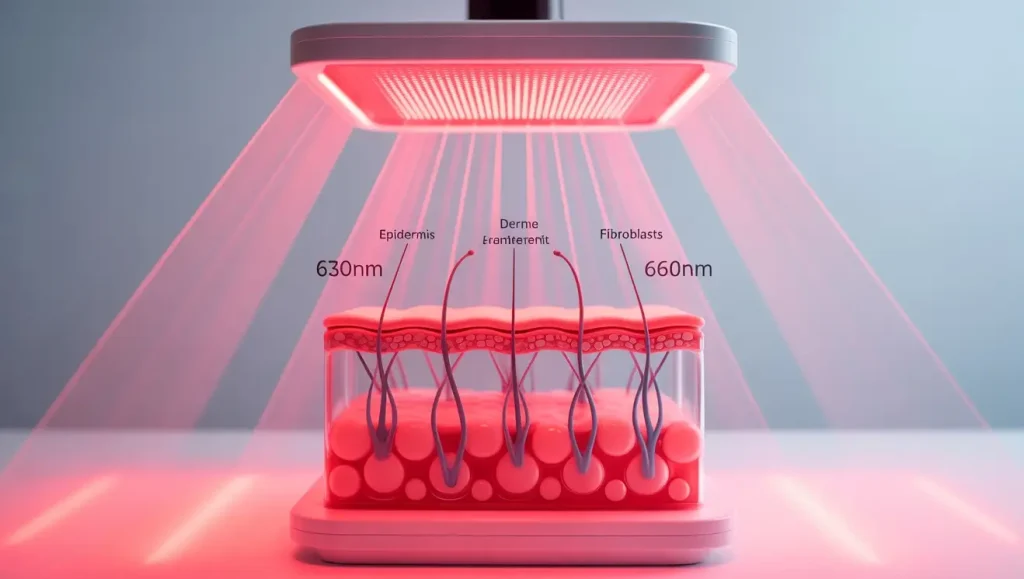
The Optical Window of Skin:
Not all light is created equal. The human body does not absorb all colors of light in the same way. For therapeutic purposes regarding skin healing, there is a specific “optical window” where light can penetrate the skin barrier without being blocked by water or melanin.
The most researched wavelengths for skin healing fall between 630nm and 670nm (visible red light) and 810nm to 850nm (near-infrared light). For treating surface-level texture and acne scars, the 630nm to 660nm range is crucial.
Why 630nm-660nm is Critical:
Wavelengths in the 630nm to 660nm range are ideal for targeting the skin’s texture.
- Absorption: This wavelength is readily absorbed by the skin tissue rather than passing through it or being reflected.
- Depth: It penetrates roughly 1-2 millimeters into the tissue. This is exactly where the sebaceous glands, fibroblasts, and the collagen network reside.
- Safety: This range is non-ionizing, meaning it does not carry enough energy to damage DNA or cause cancer, unlike UV rays.
When considering red light therapy for acne scars, ensuring the light source utilizes these specific wavelengths is scientifically imperative. Blue light, for instance, targets bacteria on the surface, but it does not reach the depth required to stimulate the collagen remodeling necessary for scar reduction.
5. Clinical Science vs. Home Application:
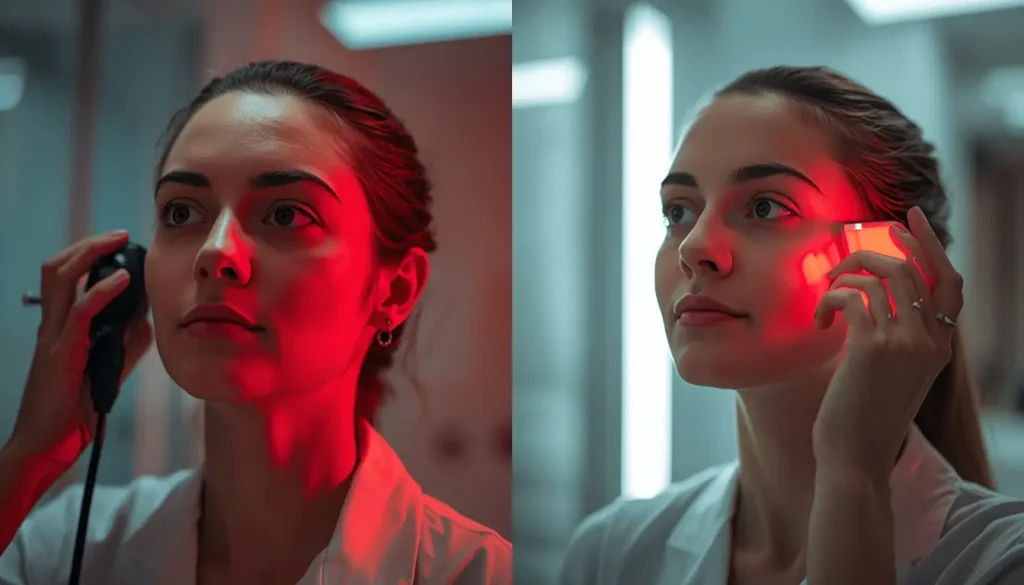
Power Density and Irradiance
The effectiveness of photobiomodulation depends heavily on “dose.” In scientific terms, this is often referred to as irradiance, measured in milliwatts per square centimeter (mW/cm²).
Clinical devices found in dermatologist offices generally have a much higher power output than home devices. This means a clinical session might take only 10 minutes to deliver the required energy dose (Joules) to the cells. Home devices often have lower power outputs, meaning the user must increase the duration or frequency of use to achieve a similar biological effect. It is not that home habits cannot be effective; it is that the variable of time must be adjusted to compensate for lower power.
The “Biphasic Dose Response”
Biology follows a curve. There is a concept in photomedicine known as the Arndt-Schultz Law, or the biphasic dose response.
- Too Little: If the energy dose is too low, there is no stimulation of the cells. Nothing happens.
- Optimal: There is a “sweet spot” where cellular activity is maximized.
- Too Much: If the dose is too high, the stimulation can actually become inhibitory. The benefits plateau or, in extreme cases, decrease.
This is why “more is not always better.” Using red light therapy for acne scars for three hours a day will not heal the skin three times as fast. In fact, it might stall the progress. Adhering to evidence-based durations (usually 10 to 20 minutes) ensures you stay within the therapeutic window.
6. Realistic Timelines and Expectations:
The 28-Day Skin Cycle:
Human skin regenerates in cycles. For an average adult, the full turnover of the epidermis takes roughly 28 to 40 days. However, scar tissue involves the deeper dermis, which changes much slower than the surface skin.
Because we are dealing with the reconstruction of the collagen matrix, patience is biologically required.
- Weeks 1-4: Users typically report a reduction in inflammation and a “glow.” The active acne may calm down, and redness (erythema) decreases.
- Weeks 4-8: Slight improvements in skin texture and pore size may become visible as the initial collagen induction begins.
- Weeks 12+: This is the benchmark for visible changes in scarring depth. By this point, the fibroblasts have had time to produce significant structural proteins, and the skin has undergone several turnover cycles.
Managing Expectations
It is vital to approach this therapy with a scientific mindset. Red light therapy is not a magic eraser. It is a biological accelerator. Deep, tethered scars may see only marginal improvement, while shallower, rolling scars often see significant smoothing. It is a tool for improvement and health, rather than perfection.
Educational resources from Harvard Health Publishing explain that collagen remodeling and dermal repair occur gradually, often requiring several weeks to months depending on scar depth and individual healing capacity. This biological timeline supports why light-based therapies emphasize consistency and long-term cellular support rather than immediate cosmetic change.
Safety Profile and Contraindications:
Non-Invasive and UV-Free
One of the primary advantages of red light therapy for acne scars is its safety profile. Unlike the sun or tanning beds, therapeutic red light devices do not emit Ultraviolet (UV) radiation. UV rays damage DNA and break down collagen (photoaging), whereas red light stimulates repair.
The American Academy of Dermatology notes that LED therapies are generally safe for all skin colors. Because the therapy does not rely on thermal heat to “burn” the skin (like some lasers), it carries a very low risk of hyperpigmentation for those with darker skin tones (Fitzpatrick scale IV-VI), making it a versatile option.
Potential Side Effects
While rare, some individuals may experience:
- Temporary Eye Strain: Though generally safe, the light is bright. It is often recommended to close eyes or wear protective goggles during sessions.
- Mild Tightness: Some users report a feeling of tightness or dryness immediately after use, likely due to increased blood flow.
- Photosensitivity: Individuals taking medications that increase light sensitivity (such as isotretinoin or certain antibiotics) should consult a physician before starting any light-based therapy.
Tools & Resources: Red Light Therapy For Acne Scars
To successfully integrate this biology-based approach into your life, focus on habits and tracking rather than just hardware.
Behavioral Tools:
- The Consistency Calendar: Since results are cumulative, mark an ‘X’ on a physical calendar for every day you complete a session. Aim for 4-5 days a week.
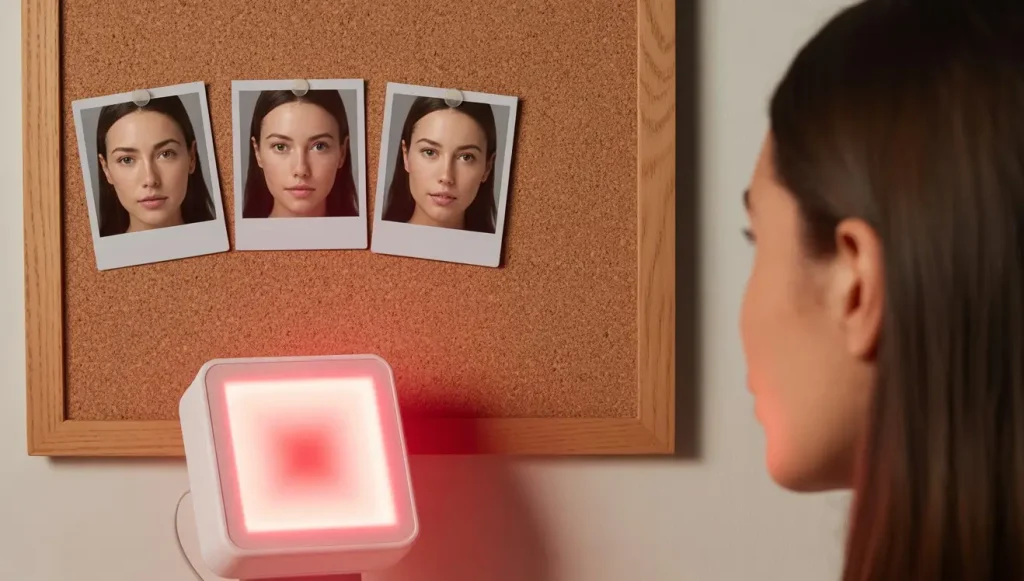
- Standardized Progress Photos: Our brains are poor at noticing slow, gradual changes. Take photos every 30 days in the exact same lighting and exact same angle. This is the only way to objectively track the remodeling of scar tissue.
- Skin Hydration Log: Hydrated cells function better. Ensure you are maintaining adequate water intake and using a non-comedogenic moisturizer to support the skin barrier while it heals.
Concept:
- “Stacking” Habits: Perform your session while doing something passive, like listening to a podcast or meditating. This reduces the friction of the activity and makes it easier to maintain the 12-week consistency required for results.
REAL HUMAN STORIES:
The Long Game: Sarah’s Story Sarah, a 28-year-old graphic designer, struggled with rolling scars on her cheeks after years of cystic acne. She began red light therapy expecting immediate results but saw nothing for the first month. Frustrated but determined, she committed to the biology of the “12-week rule.” By week 9, she noticed that her makeup applied more smoothly. By week 14, the “shadows” cast by her scars in harsh overhead lighting had softened significantly. Her story illustrates that the biological process of collagen synthesis cannot be rushed; it can only be supported.
Mark’s Approach to Inflammation Mark dealt with persistent redness and post-inflammatory hyperpigmentation that made his skin look textured even when it was smooth to the touch. He utilized red light specifically to target inflammation. Unlike chemical peels which often left his sensitive skin raw, the light therapy calmed his complexion. After two months of daily 15-minute sessions, the angry red undertone of his skin faded, revealing that much of what he thought was permanent scarring was actually lingering inflammation.
Frequently Asked Questions (FAQ):
Q: Can I use red light therapy every day?
A: Yes, in most cases, daily use is safe and effective. However, consistency is more important than frequency. Using it 4-5 times a week is often sufficient to stimulate the mitochondria without hitting a plateau. Always follow the specific guidelines of your device regarding duration.
Q: Does red light therapy hurt?
A: No. The treatment is non-invasive and painless. You may feel a gentle warmth due to increased blood circulation in the area, but there should be no burning or stinging sensation. If you feel heat, the device may be too close to your skin.
Q: Can I use red light therapy while using retinol or acids?
A: Generally, yes, but caution is advised. Retinoids and exfoliating acids can make the skin more sensitive. It is often best to apply red light therapy on clean, bare skin before applying active topical treatments. If you experience irritation, alternate days between the light therapy and strong topicals.
Q: Will red light therapy cause more breakouts?
A: It is unlikely. In fact, many users find that it helps reduce active acne. While red light focuses on healing and collagen, blue light is typically used to kill acne bacteria. Some therapies combine both. Red light itself is anti-inflammatory, which can help calm existing breakouts.
Q: How long do results last?
A: The collagen produced through red light therapy for acne scars is permanent, just like any other tissue in your body. However, the skin continues to age naturally. Maintenance sessions (1-2 times a week) after the initial treatment phase can help preserve skin health and collagen density over time.
Final Verdict:
Red light therapy represents a shift from “correcting” skin to “supporting” it. By understanding the biological mechanisms specifically mitochondrial activation and fibroblast stimulation we can see why this therapy is a viable option for treating acne scars. It is not a quick fix, but rather a commitment to cellular health.
The evidence supports red light therapy for acne scars as a safe, non-invasive method to improve skin texture and reduce inflammation. Success lies in respecting the biological timeline: consistent application over 8 to 12 weeks is necessary to allow the skin to rebuild its collagen matrix from the inside out. For those seeking a gentle, science-backed approach to skin recovery, this therapy offers a promising path forward.